
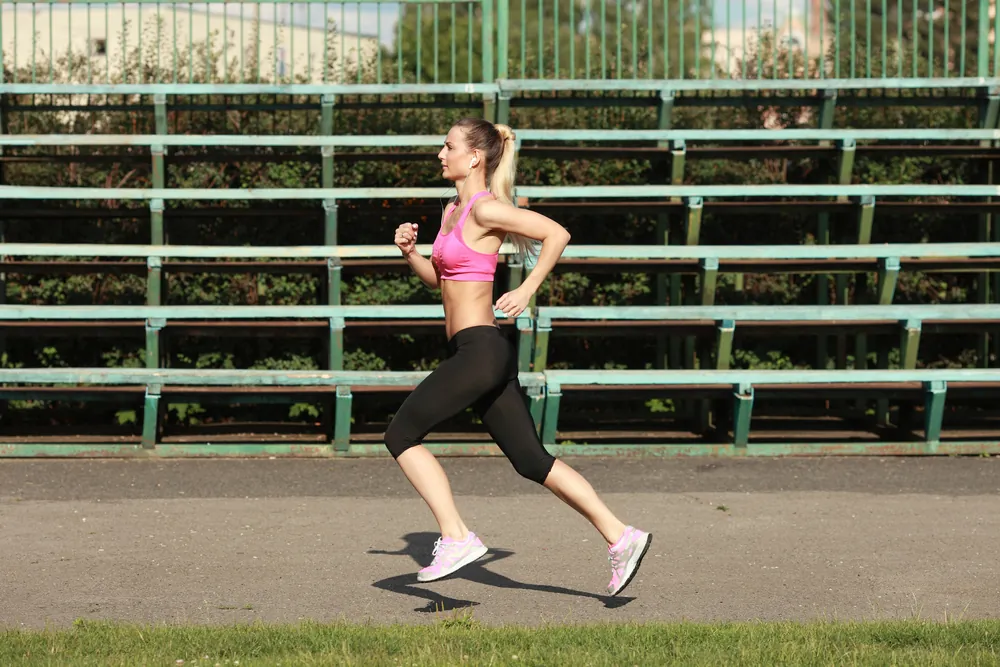
Running uses your whole body. With every stride, your body does two things: it absorbs the shock of landing, then it pushes you forward. How well you do both ie. how much of that landing energy you soak up, store, and use again like a spring, determines how efficient your running is. That's exactly why the muscles below, and how you train them, make such a big difference to both staying injury-free and running well.
The key muscles you use when you run
- Calf muscles: These work with your Achilles tendon like a spring: absorbing energy when your foot lands, then releasing it to help push you off. In one study, 14 weeks of calf training made the muscles around 7% stronger, made the tendon around 16% mechanically stiffer (which helps it store and release energy better), and cut the energy cost of running by 4% (Albracht & Arampatzis, 2013).
- Glutes (the main one): Your biggest butt muscle drives you forward, especially running uphill or picking up speed. Studies show heavy strength training for this muscle improves running efficiency (Eihara et al., 2022).
- Glutes (the side one): This muscle controls your hip and knee while you're balanced on one leg, stopping your knee from caving inward. Weakness here has been linked to a common outer-knee running injury (ITB syndrome), though the evidence for other injuries is less clear (Fredericson et al., 2000; Mucha et al., 2017).
- Hamstrings: These slow your lower leg down just before your foot lands, and also help drive your hip forward, especially on hills. A specific hamstring exercise (the Nordic curl) has been shown to cut hamstring injuries by around half (Al Attar et al., 2017).
- Quads (front of thigh): These absorb shock every single time your foot hits the ground. Official guidelines for returning to running after a shin stress fracture recommend building quad strength (George et al., 2024).
- Core (stomach and back muscles): These stop your body twisting and leaning side to side, so the power from your legs and arms works together efficiently instead of leaking away. Exercises that resist twisting (like the Pallof press) train this directly.
Why strength training helps: three reasons
- Stiffer, springier tendons: Heavy strength training makes tendons (like the Achilles and the one below your kneecap) better at storing and releasing energy, which means you use less oxygen at the same pace (Albracht & Arampatzis, 2013).
- A more efficient nervous system: Training improves how quickly and effectively your muscles fire, so the same running pace takes less effort and less oxygen (Eihara et al., 2022).
- Muscles and bones that can handle more: Stronger muscles, tendons and bones can absorb more force before they're at risk of injury. This is the main theory behind why strength training helps prevent injuries (Chwajta et al., 2026).
What the research actually says
For performance: A 2022 review pulling together 22 studies found heavy strength training gives a small but genuine boost to running efficiency, and it works better than jump-based training alone (Eihara et al., 2022).
For injury prevention: A 2026 narrative review found strength training on its own doesn't reliably cut down the overall number of running injuries, but it does reliably build the strength and control that's linked to staying resilient. The one clear exception is hamstring injuries, where the Nordic curl has the strongest supporting evidence of any single exercise, though some researchers argue the size of that effect is still unsettled (Chwajta et al., 2026; Al Attar et al., 2017).
The bottom line
Two well-designed strength sessions a week (focused on slow, controlled lowering movements, tendon strength, and single-leg balance and control) is where the evidence is strongest. But strength training isn't a substitute for building up your running mileage sensibly, which is still the number one thing that causes